New Delhi: A high-stakes competition is unfolding in India’s defence shipbuilding sector, with state-run Mazagon Dock Shipbuilders Limited (MDL) and private engineering major Larsen & Toubro both advancing competing indigenous designs for the Indian Navy’s upcoming Project-76 submarine programme.
The initiative is emerging as one of India’s most ambitious underwater warfare projects, aimed at strengthening domestic submarine design capability and reducing long-term dependence on foreign platforms.

MDL’s “Super Kalvari” Concept Builds on Proven Platform
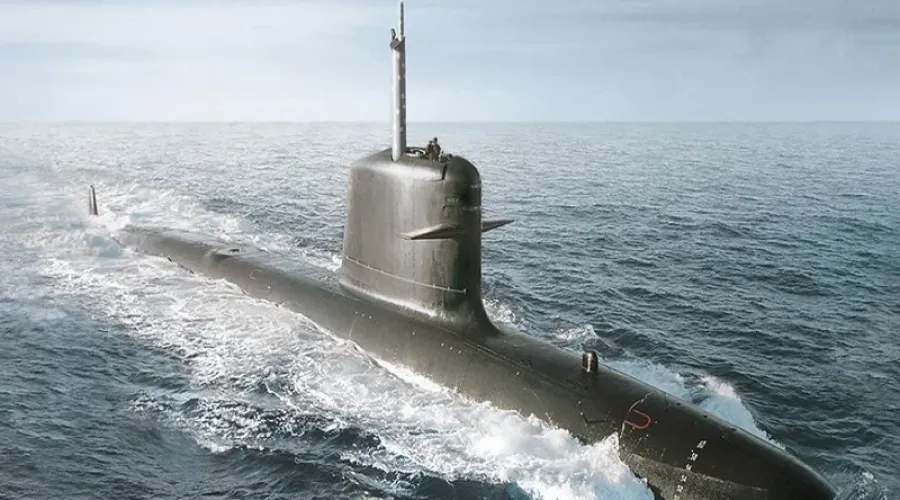
MDL is reportedly developing an advanced 3,000-tonne conventional submarine concept, internally referred to as the “Super Kalvari.” The design evolves from the existing Kalvari-class lineage, which itself is based on the Scorpène-class architecture.
The upgraded platform is expected to focus on improved stealth characteristics, a larger hull form, and enhanced acoustic suppression systems, while retaining the operational reliability of the current fleet.
With deep experience in submarine construction and lifecycle support, MDL is positioning itself as a strong contender for the Project-76 contract.
Project-76 Aims for a Fully Indigenous Submarine Fleet
Project-76 represents a major shift toward indigenous design and manufacturing in India’s underwater warfare capability. The Indian Navy is reportedly planning a fleet of up to 12 next-generation conventional submarines to replace ageing platforms and strengthen long-term operational readiness.
The programme is expected to target 70–80% indigenous content, incorporating domestic combat systems, sensors, and propulsion technologies developed in collaboration with Indian defence research agencies.
Key features under consideration include advanced Air Independent Propulsion (AIP) systems developed by Defence Research and Development Organisation, lithium-ion battery integration, vertical launch systems for cruise missiles, and fully indigenous combat management suites.
L&T Pushes Modular SOV-Based Design Approach
On the other side, Larsen & Toubro is leveraging its SOV-400 concept as the foundation for its Project-76 proposal. Originally designed as a smaller special operations vessel, the modular architecture is now being scaled up to meet frontline submarine requirements.

Industry sources suggest that this approach could accelerate development timelines by avoiding a ground-up design process, while also incorporating prior engineering validation from international collaborators.
Private Sector Strength Meets Naval Expertise
L&T has steadily expanded its footprint in India’s strategic defence manufacturing ecosystem, particularly through its involvement in nuclear submarine construction and pressure hull fabrication for the Arihant-class programme.
Meanwhile, MDL continues to dominate India’s conventional submarine segment, having played a key role in the Kalvari-class production and integration ecosystem.
Lessons from Past Procurement Programmes
The rivalry comes against the backdrop of India’s earlier submarine procurement efforts, including Project-75 and Project-75(I). In those programmes, MDL’s partnerships with foreign OEMs, including Germany’s TKMS, were selected over competing bids, while L&T has repeatedly attempted to break into the conventional submarine space through international collaborations.
Timeline and Strategic Outlook
Both MDL and L&T are expected to refine and submit their conceptual designs to the Indian Navy by around 2028, aligning with the service’s internal design and evaluation roadmap.
The Project-76 competition is widely seen as a catalyst for accelerating India’s indigenous submarine development capabilities.
Building a Self-Reliant Undersea Warfare Ecosystem
Beyond industrial competition, the programme is expected to significantly strengthen India’s maritime defence ecosystem. By encouraging parallel innovation from both public and private sectors, the Indian Navy aims to build a technologically advanced, self-reliant submarine fleet capable of meeting future strategic challenges in the Indo-Pacific region.